
Project Funds FAQ


Last updated: 03.2019

How much money is there?

Approximately, $61.7 million of the 1115 Waiver Medicaid Transformation Project (MTP) Funds are available to the BHT region to earn over the five-year transformation period. ACHs will receive all earned DY 1 funds through the FE Portal in one lump sum. Earned funds in DY 2-5 will be distributed semi-annually, aligned with pay-for-reporting (P4R) and pay-for-performance (P4P) measurement cycles.

How will Partnering Providers earn Medicaid Transformation Project Funds?

The BHT Board will approve the policy for all MTP Fund distribution. This policy will be informed by recommendations from the BHT Technical Councils including the Waiver Finance Workgroup, Provider Champion Council, Community Voices Council, Tribal Partners Leadership Council, and Community Based Care Coordination (Hub Council). In order to be eligible to earn MTP Funds, an organization must have completed an MOU.

How much money has been allocated to date?

The Waiver Finance Workgroup has approved the following allocation breakdown of Project Funds:

55% will be allocated to Collaboratives

Approved allocations to date include:

  • $4,000 for any Provider Partner who completes an MOU

  • $5,000-$50,000 for a behavioral health or primary care Partnering Providers who attest to a Medicaid patient mix of greater than the region’s 10% of communities of color

  • $5,000-$50,000 for any behavioral health or primary care Partnering Providers who attests to a Medicaid patient volume above 2,500-50,000 patients

  • $10,000 for any behavioral health Partnering Providers completing an Assessment

  • $15,000 for any primary care Partnering Providers completing an Assessment

  • $30,000 for any behavioral health Partnering Providers completing an Transformation Plan

  • $35,000 for any primary care Partnering Providers completing an Transformation Plan

30% will be allocated to Regional Infrastructure

Approved allocations to date include:

  • $50,000 for each rural county Collaborative Management Lead

  • $400,000 for Spokane County Collaborative network management

  • $450,000 for Year 1 Pathways Implementation and evaluation

10% will be allocated to Community Resiliency Fund

No funds have been allocated at this time. It is expected the first round of these funds will be available to be earned in late 2018 or early 2019

5% will allocated to BHT for administration of Medicaid Transformation funds

Approved allocations to date include:

  • $565,000 to BHT

How will Partnering Providers access or receive the earned funds?

All earned funds will be processed and distributive via the Financial Executor Portal. In order to access funds, Partnering Providers will have to complete a partnership agreement. As Partners earn funds, the BHT board will approve payments each month, and the FE will release the funds to Partners. Payments are made once the required milestones are met and amounts can be calculated. Distributions are available from the portal twice a month, except for certain periods in during the year when the portal is unavailable due to administrative maintenance. For more detailed information on how to receive payments, please read this post: How Do I Get Paid.


Will future money only go to primary care and behavioral health Partnering Providers?

We have not determined how resources will be allocated for years 2-5. It is possible that primary care and behavioral health will receive a majority of the funds and then allocate to other partners, but this has not been decided.

We have not identified how the Community Resiliency Fund will be allocated; we expect to release this process in late 2018 with funding being available in early 2019. We expect these funds to support linkages between social determinant of health and health care organizations. This is not intended to be the SDOH partner funding.

How will money be earned after this planning year, in years 3-5?

The region (via BHT) earns money differently than how providers earn dollars.

BHT earns the regional funds by submitting two reports to the Health Care Authority (HCA) each year. As long as we can demonstrate that we have met the anticipated milestones, we will earn 100% of the dollars.

BHT and the Waiver Finance Work Group have not yet made any additional decisions on how Project dollars will be earned by Partnering Providers other than the allocations established for this planning year (MOU, volume and equity accelerators, assessments, and Implementation Plans for behavioral health and primary care Partnering Providers).

BHT does expect that Project Fund allocations for Year 3-5 will be comprised of a combination of pay-for-reporting and pay-for-performance measures and will be informed by the Collaborative and Partnering Provider Implementation Plans. The Waiver Finance Workgroup will allocate dollars to specific improvement activities in late 2018 or early 2019. 

Does BHT need to know how a provider spent earned dollars?

BHT tracks how Partnering Providers earned their incentives; however, BHT is not required by the state to manage how the money is spent by the Partnering Providers.

The HCA has stated they will not independently implement a reporting and tracking mechanism to account for provider use of incentive funds as a component of Pay-for-Reporting expectations. However, the HCA encourages ACHs to keep detailed records of their budget and funds flow out to Partnering Providers in preparation for Implementation Plans and semi-annual reports. It is likely that BHT may be asked for further detail regarding how we are investing incentive dollars
so BHT may elect to work with Partnering Providers to capture provider-level spending of incentive dollars. Therefore, it would be a smart practice for Partnering Providers to keep detailed information on how their incentive payments were spent.


Should the source of the payments be classified as state, federal, or private donations?

Payments from the ACH are earned incentives under a performance contract. These are not federal or state grants or awards, and therefore an organization is not required to include them on their SEFA (Schedule of Federal Expenditures) report. We recommend that partners consult their own legal or finance teams for guidance on how to categorize the funds or any other reporting questions.

Are ACHs accountable to the budget amounts by category as submitted in project plans?

The budget amounts are, and will always be, flexible during the course of the Medicaid Transformation project. It is up to BHT on how they wish to spend the funds once they earn it.


I’m a public hospital district and I received IGT funds. Who should I talk to about that?

Please email Ben Lindekugel, executive director of the Association of Washington Public Hospital Districts at benl@awphd.org. This article explains the IGT funding process in more detail.

What are the rural accelerator funds?

The rural accelerator funds were earned by each of the five rural Collaboratives ($50,000 each), to be used for supporting integration of primary care and behavioral health. It is anticipated funds will be used to support planning activities such as; staff to coordinate identified collaborative activities, technology to manage relationships and interactions among member organizations, cost to convene meetings and trainings, including materials. The funds may not be used for programs and/or services covered by Medicaid and other funders.

What are the equity accelerator funds?

The equity accelerator dollars were earned by primary care and behavioral health organizations that serve a client pool with greater than 10% racial diversity. This is meant to support organizations who take on serving a higher percentage of the underserved populations, who often correlate with a higher probability of negative health outcomes. This is a onetime payment to demonstrate the BHT’s commitment to closing the gap on health inequities.

What are the volume equalizer funds?

The volume equalizer dollars were earned by primary care and behavioral health organizations serving a higher percentage (>10%) of the Medicaid population, recognizing that the more people your practice serves the more your organization will need to do to meet Transformation goals.

What is the Community Resiliency Fund?

The Community Resilience Fund (CRF) will grow from the 10% allocation of project funds over 5 years, for a total of approximately $7.1 million, to be expended by 2022. It is meant to ignite and support regional, community-led initiatives aimed at strengthening resilience in our community through social determinant investments and key system investment to promote improved population health. We expect the Community Resilience Fund will deepen and strengthen existing investments as well as provide a model for future investments that is attentive to the ever-changing landscape.

How will the Community Resiliency Fund be spent?

No decision has been made yet on how these funds will be distributed. We will be conducting a community process to generate ideas from the region via brainstorming sessions with our council. We plan to have a model for distribution ready for board review this fall, with funds being distributed in early 2019.

Core Principles of the Fund:

  • Utilize data to drive community decision making

  • Extensive and expansive community feedback to inform where change is needed

  • Balanced community-based governance on fund distribution

  • Aligned priorities and leveraged investment across regional health and community

  • Utilize shared savings model to drive additional investment

Project Selection Process

As more details on expectations for Medicaid Demonstration Projects trickle down from HCA we are continually refining our project selection process in hopes of making it accessible to all community members interested in participating, while also focused enough to get us ready for the heavy amount of planning we’ll have to do in a very short time. We thank you all for continued feedback throughout this process. 

At the March Leadership Council meeting we announced our updated timeline for project selection, which you can view on this one pager. In summary, we are requesting a Letter of Interest from community organizations interested in collaborating on one of the optional Medicaid Demonstration Projects by May 15.

Our Board Evaluation Team will review those letters and invite selected proposals to present at a public Community Project Showcase event, where organizations “pitch” their projects in a short “Shark Tank” styled event. The Evaluation Team and audience members will evaluate project proposals against pre-determined criteria, and from there invite selected projects to continue on to join a planning team and prepare the full application. 

Alison’s slides from this presentation can be downloaded here. Though we did not have time to go over them in the meeting, this slide deck includes updated overviews of the Medicaid Transformation Projects from the most recent draft of the toolkit. 
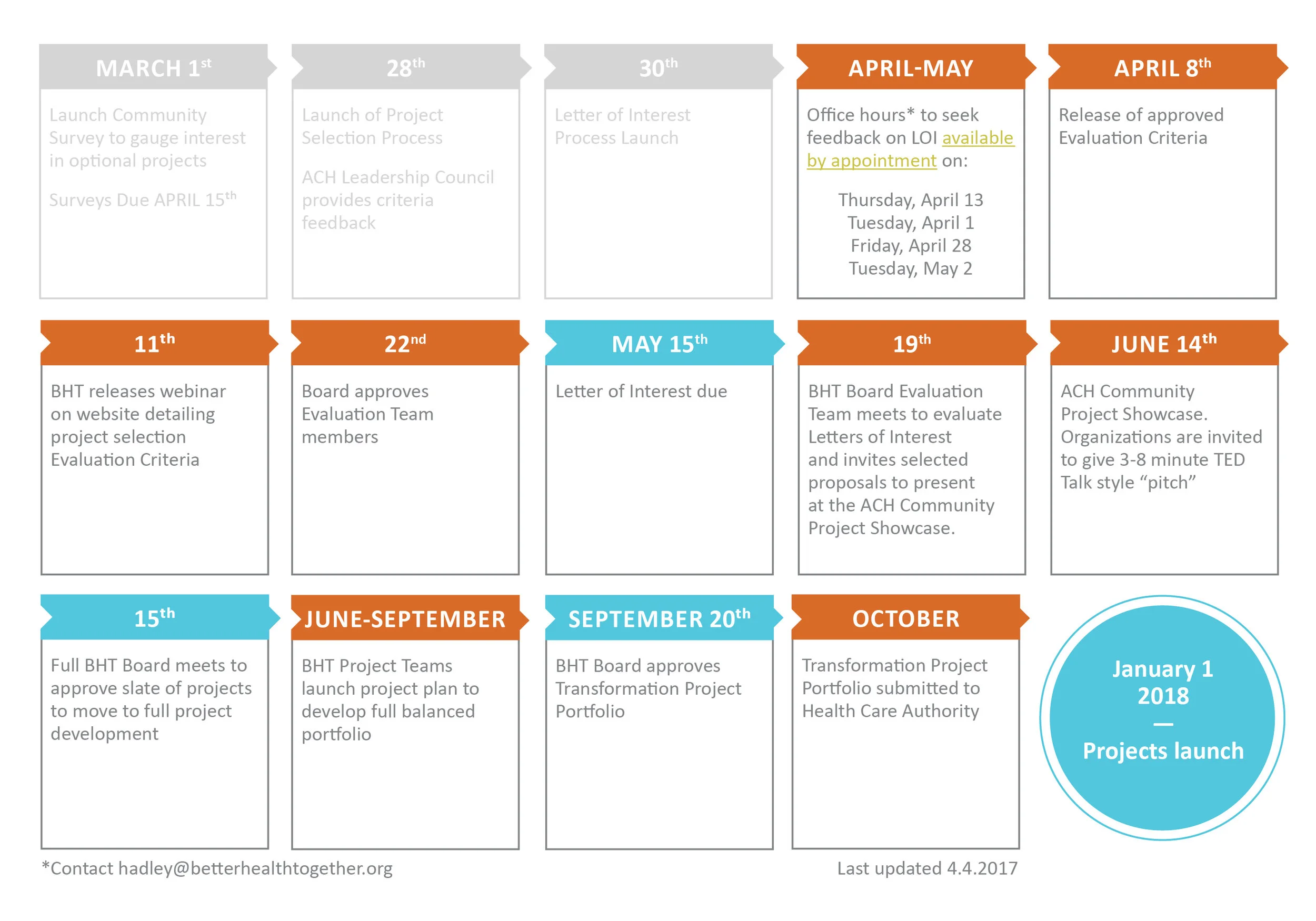
 

BHT Community Strategy Development Timeline

Throughout 2016, we hosted multiple series of community feedback sessions where we worked to learn and build out our community’s perspective on regional health improvement strategies.

January Regional Gathering:
In January we hosted our first iteration of Community Linkage Mapping, an exercise we have been building and refining throughout the year where participants inventory their organizational relationships in an effort to build a “map” of our health system. Also in this session, participants broke out into dynamic Idealized Design feedback sessions in each of our Priority Areas.

February/March Community Linkage Mapping:
At the end of February/Early March we hosted an expanded second round of Community Linkage Mapping and Idealized Design. We spent the months of March and April synthesizing the information and building out our community strategy maps. A few voiced themes from those sessions included the need to:

  • Foster a culture of self-care and personal responsibility
  • Build on opportunities for communities to nurture grassroots health
  • “Coordinate the Coordinators”
  • Build a common platform to ease information sharing and access
  • Balance coordinated decision-making across the region, while honoring self-determination in local communities

Summary of May Leadership council meeting:
In May we debuted the first draft of our community strategy maps, which represent a snapshot of the feedback we heard in the previous sessions. After, we announced the formation of Community Action Strategy Teams which would meet throughout the summer to validate and expand the identified strategies and decide on appropriate indicators measure. Each was chaired by a BHT Board Member. From June-September, we hosted feedback sessions and conducted individual outreach using the Results Based Accountability framework. The resulting updated Community Strategy Maps for Social Determinants and Population Health were debuted in September.

In October, we began working with the Spokane Regional Health District Data Center to execute a process for finalizing our Community Linkage Map. We will be surveying organizations across the region, asking them to identify their organizational relationships, which we will be able to visually inventory in a “Network Analysis” (example). This network map will help us visually represent where there are gaps of care in our health system. The map will live on the BHT website available for the public to view and explore. We will gather survey responses until December 31st, and expect to have the analysis complete in 2017.  

When this map is completed, we intend to bring back this systems level view of our region to our Community Strategy Action Teams to validate our strategies and prioritize areas of impact. 

MEDICAID WAIVER APPROVED!

As you can see, staff was pretty excited about this announcement…

After months and months on the edge of our seats, we were thrilled to hear on Monday that CMS and Health Care Authority have come to principle agreement on the Medicaid 1115 Demonstration Waiver. The five-year demonstration provides up to $1.1 billion of incentives for delivery system reform and $375 million to support critical services for Apple Health clients over five years. 

Significant stakeholder and community input informed the four goals of this demonstration plan:

  • Reduce avoidable use of high-cost services such as acute care hospitals, psychiatric hospitals, and nursing home facilities.
  • Improve population health, with a focus on prevention and proactive management of diabetes and cardiovascular disease, pediatric obesity, smoking, mental illness, and substance abuse for Apple Health clients.
  • Accelerate Medicaid payment reform to pay providers for better health outcomes.
  • Bend the Medicaid cost curve below national trend.

The specific terms and conditions will be negotiated over the coming months, so it will still be some time before those dollars start flowing to health improvement projects across the state, but we’ve just leaped a major hurdle on the track to a Healthier Washington. 

You can read more from the Governor’s media release here. 

Social Determinants of Health Strategy Map

DRAFT – Work in progress

After a summer of focus groups, we are thrilled to release an updated draft of our Community Action Strategies Map! Thank you to all who contributed feedback in one of our sessions. 

A reminded this document is very much in draft form. We intend for these maps to be a living document, that we regularly return to and update as needs and priorities change. Today, this map represents a snapshot of the most prominent themes we heard throughout the focus groups.

Background

There are many factors that lead to whole-person health and most of those factors happen outside of a doctor’s office. We have identified 6 target factors in the Social Determinants of Health: Housing, Income Stability, Food, Transportation, Education, and Community Support

Originally, the ACH Leadership Council, Social Determinants Subgroup worked on the strategy mapping for these 6 areas collectively, but it was very apparent that we needed a more systematic approach where we could engage the regional experts in targeted discussion. In August, ACH staff and SDOH workgroup co-chair Pam Tietz participated in a Results Based Accountability training hosted by THEZONEPROJECT, which presented a fortuitous opportunity to reform the workgroup into targeted community “turn-the-curve” work sessions. We split the 6 social determinants into separate work groups and asked Leadership Council members to invite any pertinent individuals or organizations to join the meeting. Our goal is to engage as many people and organizations as possible for feedback and input.

Greg Knight, the Executive Director of Rural Resources and BHT Board member co-chair of this group helped coordinated outreach sessions in rural counties. Individual outreach is still being conducted for additional organizations, and the strategy map will continue to expand. 

Through these workgroups, the group identified over 160 key partners and organizations that should be included in this work.

To date, the ACH Project Team has engaged with over 65 individuals in various work groups and outreach.